
Psychologically-Informed Practice Course Library
The
I’ve collaborated with world class professionals and organizations to develop continuing education on topics in pelvic health & psychologically-informed practice. Check out my sought after courses below!
Continuing Education Courses
Trauma-Informed
Pelvic Health Certification

Developed in partnership with Lindsey Vestal of The Functional Pelvis, this certification was created for clinicians who recognize that pelvic health care often unfolds in vulnerable emotional territory and want to feel more equipped, confident, and grounded when it does.
The first comprehensive program designed to help clinicians bring trauma-informed care into pelvic health.
Pelvic health sessions can bring forward nervous system activation, protective responses, and echoes of lived experiences or trauma histories. Yet most pelvic health training focuses on anatomy and biomechanics, leaving clinicians to navigate emotional complexity without a clear framework or support.
This program fills that gap.

Through a blend of structured online lessons, guided practices, reflective work, and live community support, clinicians learn how to:
Create conditions of safety through language, presence, and environment
Navigate emotional or protective responses with steadiness and clarity
Honour autonomy, consent, and pacing in every interaction
Utilize trauma-informed principles into every aspect of care from marketing to intake to assessment to treatment
Recognize nervous system cues and respond without escalating distress
Whether or not your practice includes hands-on or internal pelvic health work, Canadian OTs are uniquely positioned to bring a trauma-informed lens to this deeply personal area of care. This certification offers a meaningful way to deepen your confidence, expand your perspective, and strengthen the therapeutic relationships at the heart of your work, no matter how pelvic health currently shows up in your role.
It’s an immersive, supportive learning experience designed to shift not only what we do, but how we show up, so pelvic health care becomes safer and more compassionate for our clients, and more sustainable for us.
And if you’re wondering whether you need pelvic-health experience to benefit from this training: you don’t. Trauma-informed principles are an excellent place to start and despite it being Level 2 in the Functional Pelvic Practitioner Certification, there no prerequisites for this course.
As long as you’re working with humans, and even if you’re just beginning to dip your toe into pelvic health, you belong here.
CBT Skills for Distressing Physical Symptoms

A practical, clinician-focused training for working with the cognitive, emotional, and behavioural layers of challenging physical symptoms.
CBT Skills for Distressing Physical Symptoms is designed for clinicians who support clients experiencing physical symptoms that feel confusing, overwhelming, or difficult to treat with biomedical strategies alone.
Whether the symptoms relate to pain, pelvic health, fatigue, concussion, or other distressing sensations, this course helps clinicians understand the patterns that often keep our clients stuck in distress and obtain practical, evidence-based techniques to help shift them out of these patterns safely and collaboratively.
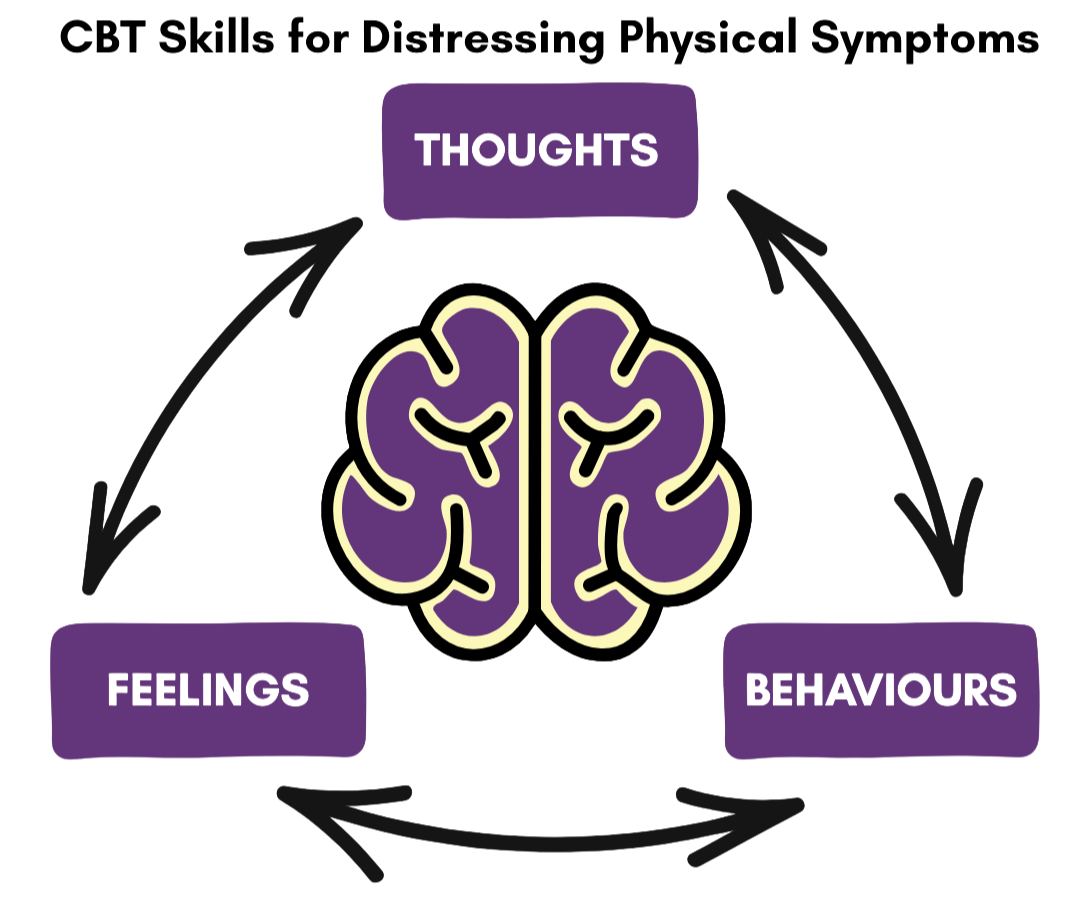
Through digestable lessons, clinical examples, a demonstration land a plethora of accessible worksheets and tools, a clinicians learn how to:
Recognize cognitive and behavioural patterns that heighten symptom distress.
Explore symptom experiences using validating, non-pathologizing language
Help clients shift from avoidance and fear toward confidence and meaningful engagement
Introduce CBT skills such as cognitive reframing, behavioural activation, pacing, and functional exposure
Integrate CBT principles into everyday assessment, treatment planning, and functional goals
Rehabilitation training rarely addresses how thoughts, emotions, nervous system activation, and protective behaviours can amplify physical symptoms.
CBT Skills for Distressing Physical Symptoms expands what’s possible when symptoms persist despite standard treatment, helping clinicians feel more grounded, confident, and effective in their approach.
This course fills that gap by offering practical CBT-informed strategies you can integrate immediately into your existing practice.
ACT: A Practical Guide for Rehabilitation Providers
A skills-focused ACT program designed to help clinicians apply psychological flexibility principles directly to rehabilitation, pain care, and meaningful daily function.
ACT: A Practical Guide for Rehabilitation Providers was created for clinicians who recognize that supporting clients means working with more than symptoms alone. Clients often struggle with the relationship that they have with persistent and distressing symptoms.
Acceptance and Commitment Therapy (ACT) offers an evidence-based, compassionate framework for helping clients navigate their experiences with greater psychological flexibility while moving toward what matters.
But many clinicians, whether new to ACT or already familiar with its principles, struggle with one key question:
“How do I actually use ACT in my day-to-day clinical practice?”
Through a blend of structured online lessons, guided practices, reflective work, and illuminating clinical examples, clinicians learn how to:
Understand patterns of avoidance, fusion, and control that maintain distress and limit engagement
Introduce ACT processes in simple, relatable language clients can immediately connect with
Foster values-based action that aligns with meaningful daily life
Help clients build openness to difficult sensations, emotions, and thoughts
Integrate ACT seamlessly into assessment, treatment planning, goal setting, and occupation-centred work
You’ll leave with a clear foundation in ACT’s core processes and the confidence to tailor an ACT approach to your own caseload.
Moving from Fixer to Facilitator:
An Introduction to Psychologically Informed Strategies for Pain Clinicians
A practical, clinician-focused training for working with the cognitive, emotional, and behavioural layers of challenging physical symptoms.
This course is designed for clinicians grounded in biomechanical or physiology-based models who are just beginning to explore how psychological and behavioural factors influence pain, recovery, and participation.
Many providers feel confident treating tissue-level contributors but less prepared when clients express fear, avoidance, frustration, or emotional distress in relation to their symptoms.
This course offers a supportive first step as a part of Reframe Rehab’s Biopsychosocial Bundle.
Rehabilitation training rarely addresses how thoughts, emotions, nervous system activation, and protective behaviours can amplify physical symptoms. This course fills that gap by offering practical CBT-informed strategies you can integrate immediately into your existing practice.
Through accessible concepts, reflective exercises, and real-world clinical examples, learners gain insight into how to:
Understand the psychological processes that shape pain and symptom experiences
Shift from a “fixing” stance to a collaborative, facilitative clinical approach
Introduce simple, psychologically informed strategies from Polyvagal Theory, CBT, and ACT into everyday practice
Build comfort navigating emotional and behavioural components of complex presentations
Recognize patterns that keep clients stuck in cycles of distress or avoidance
It’s the perfect starting point for rehabilitation clinicians who want to broaden their lens before diving deeper into ACT, CBT, or trauma-informed care.
Available only as part of the Biopsychosocial Bundle on Embodia.
Looking for Live or Private Training?

I’ve had the privilege of teaching these psychologically informed and trauma-informed approaches in a wide range of settings including private rehabilitation firms, professional organizations, interdisciplinary clinics, university programs, national associations, and conferences across North America.
If your team is interested in a live workshop, a private course, webinar or tailored professional development in ACT, CBT skills, psychologically informed practice, trauma-informed care, or occupation-based approaches to pelvic health, I’d love to connect.
Get in touch to discuss options for bringing Pelvic Resilience Education to your group.
Whether your goal is to build a pelvic health caseload, weave pelvic health conversations into everyday OT practice, navigate complex pain presentations, or integrate psychotherapeutic approaches into the work that you do, you’re in the right place.
This is a community for clinicians who want to grow with intention, stay grounded in their values, and feel supported in the work that matters most.